
Profit is the domino that knocks over all other dominoes
One of the most frustrating realities for established business owners is that visible success does not always translate into meaningful profit.
Turnover may be approaching £1 million. The team may be busy. Customers may be buying. The order book may look healthy.
However, after labour, suppliers, overheads, finance costs, tax and owner drawings, too little remains. Cash flow stays under pressure. Investment is delayed. The owner remains involved in every decision because the business cannot comfortably fund the people or systems needed to reduce that dependence.
This is rarely caused by one dramatic mistake. More often, profit is being weakened by a series of smaller commercial decisions that have accumulated over time.
Prices have not kept pace with costs. Discounts are being applied inconsistently. Low-margin work is absorbing capacity. Marketing produces activity but not enough qualified opportunities. Existing customers are not being developed. Overheads have grown faster than gross profit.
The solution is not always to pursue more revenue.
In many businesses, the more important objective is to improve profit through several connected actions. Profit is the domino that knocks over all the others. It creates cash, resilience, investment capacity, owner freedom and stronger future options.
Profit is the input. Optionality is the output.
Profit solves more than a bottom-line problem
Profit is often treated as the final number at the bottom of the management accounts. That understates its strategic importance.
A stronger profit position can improve several areas of the business at the same time.
1. Profit reduces cash flow pressure
Profit and cash flow are not identical. A profitable business can still experience cash pressure because of late collections, stock purchases, tax liabilities or debt repayments.
However, a higher margin gives you more cash generated from each sale. That provides greater room to absorb timing differences between money leaving the business and money arriving.
If a customer pays late, a stronger business has more capacity to manage the gap. If a supplier changes terms, the impact is less destabilising. If an unexpected repair or regulatory cost appears, you have more options than simply reaching for additional borrowing.
2. Profit reduces the need to borrow
Borrowing is sometimes appropriate. It can fund equipment, stock, recruitment or acquisition when the underlying economics are sound.
But borrowing is a weaker solution when it is being used to compensate for insufficient margin.
Improving profit allows the business to fund more of its own requirements. That reduces interest costs, repayment pressure and reliance on external decisions. It also gives you greater control over the timing and scale of investment.
3. Profit funds investment with less risk
Many businesses know what they need to improve but cannot justify the cost.
The business needs better systems, stronger sales capability, improved reporting, additional management capacity or a more effective digital presence. Yet investment is continually postponed because the current margin does not provide enough confidence.
Higher profit changes that calculation. It allows you to invest from a position of greater strength rather than waiting until the business is forced to act.
4. Profit creates owner freedom
An owner who is constantly firefighting is often not dealing with a motivation problem. They are dealing with an infrastructure problem.
The business may not generate enough surplus to employ an operations manager, strengthen finance support, delegate customer relationships or document key processes.
Profit creates the capacity to build that infrastructure. It allows the owner to replace personal effort with capable people, repeatable processes and clearer management information.
5. Profit improves resilience
A business with a 10% net profit margin has less room for error than one with a 20% margin.
A lost customer, a bad quarter, a supplier failure or an unexpected cost can remove a significant portion of annual profit. The business may still survive, but the owner is forced into reactive decisions.
Improving profit creates a buffer. It does not eliminate commercial risk, but it gives the business more time and more choices when conditions change.
6. Profit strengthens enterprise value
A profitable business is not automatically valuable. Buyers also consider customer concentration, management depth, recurring revenue, systems, market position and risk.
However, sustainable profit is a central component of enterprise value. It affects the earnings base to which a valuation multiple may be applied, while also giving a buyer greater confidence in the quality of those earnings.
A business that generates more profit, with less owner dependency and stronger reporting, is generally better placed to create future options.
Those options may include growth, partial sale, full exit, succession or simply greater personal freedom.
The difference is made by compounding
The mistake many owners make is to look for one major breakthrough.
They search for the new product, the large contract, the major cost reduction or the marketing campaign that will transform the business.
Those opportunities sometimes exist. But a more reliable approach is to identify a series of smaller improvements and apply them across the commercial model.
A 2.5% improvement in one area can appear insignificant. Twelve 2.5% improvements applied across different areas can create a material change in profit.
This is because the improvements do not operate in isolation. A better price improves gross profit. More leads create additional opportunities. A stronger offer improves conversion. A successful upsell increases revenue from existing customers. Lower costs allow more of the additional revenue to reach the bottom line.
Each action improves the base on which the next action operates.
Start with the price increase most owners avoid
Consider a business generating £1 million in revenue, with a 10% net profit margin and a 45% gross profit margin.
Its current net profit is £100,000.
Within the Profit Acceleration Simulator illustration, a 2.5% price increase produces a profit increase of £26,266.
That is the largest individual impact among the twelve initial profit levers.
The practical reason is straightforward. A price increase does not usually require additional production, delivery capacity or headcount. Once implemented, much of the increase can flow through to gross profit, subject to the business’s cost structure and any effect on demand.
Yet many owners avoid reviewing prices because they fear losing customers.
That concern should not be dismissed. Pricing changes need to be considered by customer, product, service, contract and competitive position.
However, a blanket assumption that every customer will leave is rarely supported by evidence. Many businesses have customers who value reliability, expertise, speed or outcomes more than a small difference in price.
The appropriate response is not to increase prices without analysis. It is to establish pricing governance.
Review where prices are below target. Separate high-value customers from low-margin accounts. Identify services with strong differentiation. Test changes in a controlled way. Monitor volume, conversion, gross margin and customer response.
A 2.5% price increase may look small. In this example, it is worth more than £26,000.
The twelve profit levers
The Profit Acceleration Simulator uses twelve initial profit areas to show how small changes can compound across a business.
For the £1 million example, applying a 2.5% improvement in each area produces the following illustrative profit increases:
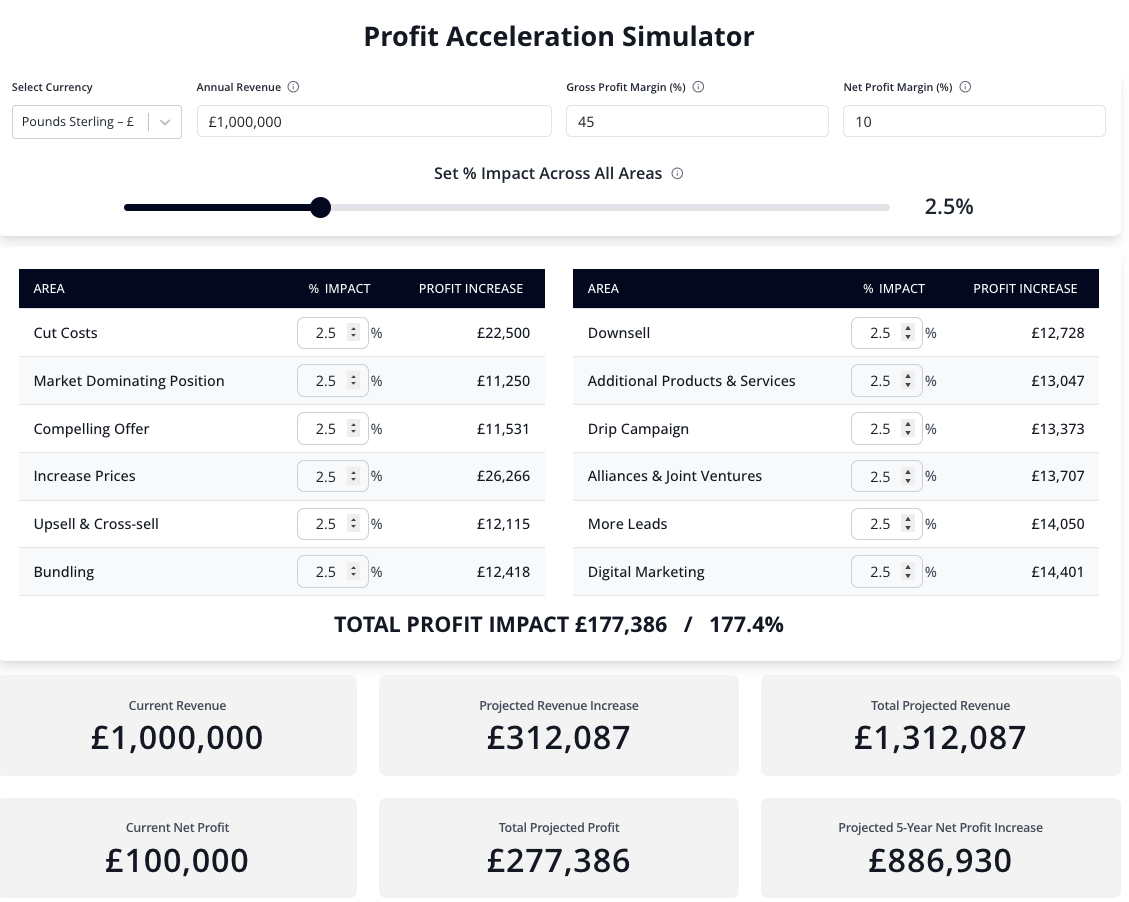
The figures are an illustration, not a guarantee. The actual result will depend on the business model, starting margins, capacity, customer behaviour and quality of implementation.
The important point is the pattern.
The improvement is not dependent on one dramatic action. It comes from combining pricing, cost control, marketing, sales conversion, customer development and market positioning.
What the combined illustration shows
When the 2.5% improvements are applied across all twelve areas in the simulator example, the projected figures are:
Current revenue: £1,000,000
Current net profit: £100,000
Projected revenue increase: £312,087
Projected revenue: £1,312,087
Total projected net profit: £277,386
Total profit impact: £177,386
Increase in profit: 177.4%
Projected five-year net profit increase: £886,930
This is why isolated improvement plans often underperform.
If you only focus on lead generation, you may create more sales activity without enough margin. If you only reduce costs, you may damage capability or constrain growth. If you only increase prices, you may miss significant opportunities in customer value, conversion and product mix.
The stronger approach is to examine the whole commercial system and identify how the levers reinforce one another.
A practical 30-day profit review
You do not need to tackle all twelve areas at once. You do need a disciplined process for deciding where to start.
1. Establish the baseline
Review the last twelve months and confirm:
Revenue by product, service, customer and channel
Gross profit and gross margin
Net profit and net margin
Direct costs and overheads
Average order or contract value
Customer retention and repeat purchase levels
Debtor days and cash collection timings
Do not rely only on business-wide averages. A profitable headline figure can conceal loss-making customers, services or territories.
2. Rank the opportunities
Identify the three areas with the greatest combination of:
Financial impact
Speed of implementation
Management control
Low risk of damaging customer value
Pricing, discounting, supplier costs and existing-customer revenue are often strong starting points because they can produce results without requiring substantial additional capacity.
3. Separate assumptions from evidence
Write down the concern attached to each proposed action.
For example:
“Customers will reject a price increase.”
“The sales team needs more leads.”
“We cannot reduce this overhead.”
“The market will not pay for a higher-value package.”
Then identify what evidence would confirm or challenge each assumption.
Review customer profitability. Analyse lost quotes. Compare conversion rates by price point. Examine the workload created by low-margin services. Speak to customers about outcomes rather than assuming that price is their only consideration.
4. Assign ownership and measures
Each action needs a named owner, a deadline and a measurable outcome.
A pricing review may be measured through average realised price, gross margin and retention. A marketing improvement may be measured through qualified leads and conversion. A cost initiative may be measured through supplier rates, waste or overhead as a percentage of revenue.
Without clear measures, profit improvement becomes a collection of intentions.
5. Review the profit bridge monthly
Establish a monthly profit bridge showing what changed from the previous period:
Price and discounting
Volume and customer mix
Direct costs
Labour efficiency
Overheads
Marketing performance
Cash collection
This prevents improvements from disappearing into the general management accounts. It also creates a management discipline that helps stop the same margin leaks recurring.
Profit is the foundation for better choices
Profit does not solve every business problem immediately.
It will not replace good leadership, sound delivery, accurate reporting or a credible strategy. It will not remove every risk from the market.
But profit gives you the capacity to address those issues properly.
It allows you to fund better people, improve systems, withstand disruption, reduce borrowing, delegate more effectively and build a business that is less dependent on the owner.
That is why profit should not be viewed as merely the reward for running the business well.
It is the resource that allows the business to become stronger.
The most effective improvement may be a 2.5% price increase. It may be a reduction in avoidable cost, a better offer, a structured follow-up campaign or a more disciplined approach to cross-selling.
Individually, these actions can look modest. Applied together, they can change the economics of the business.
Ready to see which profit levers could make the biggest difference in your business? Book your confidential 15-Minute Profit Simulation with James Fenner to identify the highest-impact opportunities and build a practical route to stronger profit, cash flow and future options.