
How much is my business worth? A guide for UK business owners
You may have a healthy turnover, a strong customer base and a capable team, yet still be unsure what your business would actually sell for.
That uncertainty is common. Many owners receive a single valuation figure with little explanation of how it was calculated. The result is often one of two problems: the business is over-valued because the owner focuses on effort and potential, or under-valued because important commercial strengths have not been properly evidenced.
The honest answer to “how much is my business worth?” is that it depends on the quality, predictability and transferability of your earnings.
A buyer is not simply purchasing your turnover or the years you have invested in the business. They are assessing the future cash flow they can reasonably expect to receive, the risks attached to it and how much work will be required to maintain performance after completion.
Why business value is a range, not a single number
A business does not have one permanent value in the same way that a listed share has a quoted market price.
Its value changes according to:
The strength and sustainability of its profits
The quality of its customer and revenue base
The level of owner dependency
The depth of the management team
The reliability of its financial reporting
The sector and current buyer demand
The structure of the proposed transaction
The amount of debt, cash and working capital involved
This is why two businesses with similar turnover can achieve very different valuations.
A £5 million turnover business with volatile margins, weak contracts and a heavy reliance on its owner may be worth less than a £2 million turnover business with recurring revenue, dependable management information and a diversified customer base.
The valuation process is therefore less about finding a universal formula and more about establishing a realistic range supported by evidence.
The main business valuation methods
There are several recognised business valuation methods. The appropriate approach depends on the type of business, the quality of its financial information and the reason for the valuation.
1. Earnings-based valuation
For established, profitable owner-led businesses, the dominant method is usually an earnings multiple.
The basic calculation is:
> Enterprise value = Normalised EBITDA × appropriate valuation multiple
EBITDA means earnings before interest, tax, depreciation and amortisation. It is used as a measure of operating performance before financing decisions and certain non-cash accounting charges.
However, buyers rarely use reported EBITDA without review. They usually calculate normalised EBITDA, which means adjusting the reported figure to reflect sustainable trading.
Potential adjustments may include:
One-off legal or restructuring costs
Unusual income that is unlikely to recur
Personal expenses charged through the business
Above- or below-market owner remuneration
Family payroll that does not reflect an ongoing business requirement
Rent or other related-party costs that are not at market rates
Normalisation is not an opportunity to make the figures look better artificially. A buyer will test every adjustment. The purpose is to show what the business would reasonably earn under normal ownership and operating conditions.
The multiple then reflects the risk and quality of those earnings. A higher multiple is generally associated with predictable profit, recurring revenue, a capable management team, strong customer retention and clear growth prospects.
2. Discounted cash flow
A discounted cash flow, or DCF, valuation estimates the future cash the business is expected to generate and converts it into a present value.
The method involves:
Forecasting future cash flows
Estimating a terminal value beyond the forecast period
Applying a discount rate to reflect risk
Calculating the present value of those future amounts
DCF can be useful where a business has a clear, credible growth trajectory or where historic earnings do not fully represent its future potential.
It is also sensitive to its assumptions. Small changes in the growth rate, margin forecast or discount rate can materially change the outcome. For that reason, DCF is usually best used as a supporting method rather than the only valuation approach for an owner-managed business.
3. Comparable transactions
Comparable transaction analysis looks at the prices paid for similar businesses.
The most useful comparisons consider:
Sector and business model
Turnover and profitability
Geographic market
Customer concentration
Recurring or contracted revenue
Management structure
Transaction timing
This method is grounded in actual market activity, but reliable transaction data is not always publicly available for private UK businesses. Headline multiples can also be misleading if the businesses being compared differ significantly in quality or risk.
A multiple paid for a larger, professionally managed company should not automatically be applied to a smaller business that depends heavily on its owner.
4. Asset-based valuation
An asset-based valuation estimates the value of the company’s assets after deducting its liabilities.
This can be appropriate for:
Property businesses
Plant- and equipment-heavy companies
Businesses holding valuable stock or specialist assets
Businesses that are being wound down or broken up
However, asset-based valuation can understate a profitable trading business.
A service company may have limited tangible assets but valuable customer relationships, systems, intellectual property, brand strength and future earnings capacity. Those intangible assets may not appear fully on the balance sheet, even though they are central to what a buyer is purchasing.
For most established trading businesses, asset value is best treated as a cross-check rather than the complete answer.
How to value a small business UK: what changes at smaller scale
If you are researching how to value a small business UK, the mechanics are broadly similar, but the risk profile often changes at smaller scale.
A smaller business may produce attractive profits but still achieve a lower multiple because the earnings are less transferable.
Buyers will examine four issues particularly closely.
Owner dependency
If you are responsible for winning key customers, approving every decision and maintaining important relationships, the buyer may see the profit as partly dependent on your continued involvement.
That does not mean the business has no value. It means the buyer may need to discount the price, retain part of the consideration or require you to remain involved for a transition period.
Customer concentration
One large customer can make a business appear stronger than it is. If that customer represents a substantial proportion of turnover, the buyer will assess the likelihood of retention and the consequences of losing the account.
A diversified customer base generally supports a stronger valuation because it reduces the impact of any single loss.
Informal financial reporting
Many smaller businesses have accounts that are sufficient for tax and statutory purposes but not sufficiently detailed for transaction analysis.
Buyers want to understand:
Monthly revenue and margin trends
Profit by customer, product or service
Debtor ageing and cash collection
Recurring versus one-off revenue
Gross margin movement
The operational cost base
Late or inconsistent management accounts make it harder for a buyer to establish what is really happening.
A lower multiple than the headline market figure
A market article may quote a sector multiple that applies to larger or more institutional businesses. Applying that figure directly to a smaller company can create unrealistic expectations.
Smaller businesses often achieve lower multiples because they have:
Greater key-person risk
Less management depth
More concentrated revenue
Weaker systems and reporting
Less contractual certainty
A narrower pool of potential buyers
The objective is not to argue for a higher multiple. It is to understand which risks are reducing the multiple and then address those risks before a sale.
What determines the multiple a buyer will pay?
The multiple is a practical expression of buyer confidence.
A buyer is more likely to pay a stronger multiple when the business demonstrates:
Quality of earnings: Profit is generated from normal, repeatable trading rather than unusual events.
Predictable revenue: The business has recurring, contracted or reliably repeat customer income.
Margin stability: Gross and operating margins are understood and managed.
Management depth: The business can operate effectively without the owner making every important decision.
Customer spread: No single customer creates an unacceptable concentration risk.
Clean management accounts: Financial information is timely, consistent and easy to reconcile.
Growth trajectory: There is credible evidence of future demand, capacity and commercial opportunity.
Operational systems: Key processes are documented and consistently followed.
Gryphon Advisory’s Exit Acceleration framework assesses these areas through 11 value drivers. The purpose is not to produce a theoretical score. It is to identify the practical conditions that affect buyer confidence and enterprise value.
What reduces the number?
Some valuation problems are visible in the accounts. Others only become clear during buyer due diligence.
Common valuation traps include:
Owner dependency
Key relationships, approvals and commercial decisions remain concentrated with the owner.Undisclosed related-party costs
Personal or connected-party arrangements are poorly documented or difficult to normalise.Poor or late bookkeeping
Accounts are produced too slowly to support timely decisions or reliable trend analysis.One customer dominating turnover
The loss or renegotiation of one account could materially damage performance.Key-man risk without a successor
A critical employee, founder or technical specialist has no clear replacement or documented handover process.Weak commercial contracts
Customer relationships rely on informal arrangements, short notice periods or unclear renewal terms.Unclear profitability
Management cannot explain which customers, services or products generate the strongest contribution.
These risks are rarely caused by laziness or incompetence. They often develop while an owner is focused on serving customers and maintaining growth. However, they become important when a buyer needs evidence that performance can continue under new ownership.
Worked illustration: how the multiple compounds into value
The following is an illustration only. It is not a valuation, market quote or promise of achievable sale proceeds.
Assume a business has normalised EBITDA of £400,000.
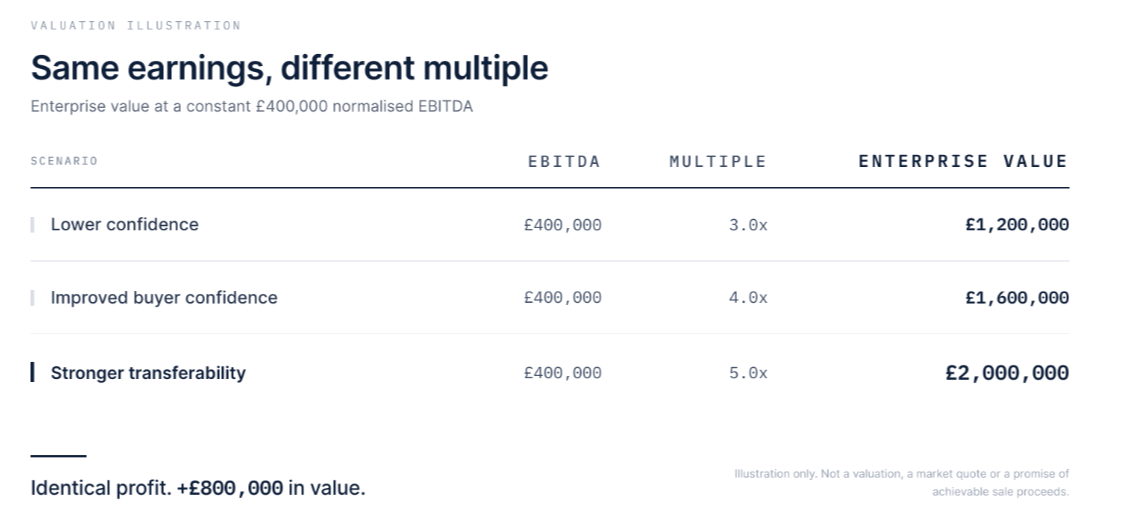
A one-turn increase from 3.0x to 4.0x creates an illustrative £400,000 increase in enterprise value without any increase in EBITDA.
That does not mean a business can simply claim a higher multiple. The increase must be supported by better evidence: more predictable revenue, reduced owner dependency, stronger contracts, improved reporting and a more resilient management structure.
The point is that profit and valuation quality compound together. A business that increases normalised EBITDA to £500,000 and improves its multiple from 3.0x to 4.0x would move from an illustrative £1.5 million enterprise value to £2 million.
What can you do over the next 12–24 months?
If you want to increase your business valuation before selling, begin well before a transaction process starts.
1. Establish a reliable financial baseline
Produce monthly management accounts with consistent definitions for revenue, gross margin, overheads, EBITDA and working capital.
Do not wait until a buyer requests this information. You need it to manage the business now.
2. Improve earnings quality
Separate recurring performance from one-off events. Review pricing, delivery costs, labour efficiency and overheads by service line or customer segment.
Small improvements in several profit areas can compound into a material increase in maintainable earnings.
3. Reduce owner dependency
Document key processes, delegate operational decisions and develop managers who can own important outcomes.
A buyer will place greater confidence in a business that operates through its systems and team rather than through the founder’s personal effort.
4. Strengthen the revenue base
Review customer concentration, renewal rates, contract length and revenue visibility.
Where appropriate, move commercially sound customers towards clearer agreements, longer commitments or recurring service structures.
5. Build a due diligence file
Organise contracts, statutory accounts, management accounts, employee information, intellectual property records, insurance documents and key supplier arrangements.
A clean data room does not create value by itself. It does, however, reduce avoidable friction and help substantiate the value you are claiming.
6. Track progress against a defined roadmap
Set quarterly priorities and measure whether the changes are improving profit, cash flow, operational independence and buyer confidence.
A 12–24 month preparation period gives you time to correct structural weaknesses rather than explaining them defensively during negotiations.
What to do next
Start by estimating a valuation range using normalised EBITDA and a cautious multiple. Then challenge the result.
Ask:
Which assumptions support the multiple?
What would make a buyer reduce it?
How much of the business still depends on me?
Can I evidence the quality and predictability of earnings?
What should be fixed before I approach the market?
A valuation is most useful when it leads to better decisions, not when it simply produces a number.
Ready to stop guessing what your business is worth? Book your confidential 15-Minute Exit Acceleration Overview with James Fenner today to unlock an actionable roadmap for your next growth horizon.